Voicebot conversational AI is transforming the way businesses handle calls, support, and everyday customer interactions. Instead of frustrating menus and long wait times, callers can simply speak in their own words and get instant, accurate help from an intelligent voice assistant.
But what is a virtual agent (¿qué es un agente virtual?)? Essentially, it’s an AI-powered system that can understand and respond to customers just like a human agent, powered by intelligent contact center AI. Whether you are looking to automate routine calls, scale your contact center, or offer 24/7 support without exploding your costs, voicebots combine the power of speech recognition and conversational AI to create natural, human-like voice experiences.
Businesses are leveraging cloud-based computing with AI to create smarter, faster, and more scalable operations. By using AI-driven platforms in the cloud, companies can access real-time analytics, automate repetitive tasks, and gather actionable insights from large volumes of customer and operational data. This approach is revolutionizing how organizations approach digital marketing using AI, enabling personalized campaigns that target the right customers at the right time, improve engagement, and boost conversion rates. Marketing with AI also allows brands to understand user behavior, forecast trends, and optimize advertising strategies more effectively than traditional methods.
Financial services are another area where AI integration is making a huge difference. Intelligent algorithms now help banks and financial institutions perform advanced risk assessments, detect fraud in real time, automate compliance reporting, and provide predictive insights for smarter investment planning. Even small and medium-sized enterprises can use AI-powered financial tools to manage budgets, forecast revenue, and streamline accounting processes.
When these technologies are combined with voicebot conversational AI, businesses create a fully integrated ecosystem where customer service, marketing, and operational intelligence work together seamlessly. Voicebots become more than just tools for handling calls; they act as a central hub that connects customers to relevant information, personalizes their interactions, and contributes to broader business objectives. The result is a more responsive, adaptive, and intelligent digital presence that not only improves customer satisfaction but also drives growth, efficiency, and innovation across the organization
What Is a Voicebot?
Avoicebotis an AI-powered virtual assistant that interacts with people through spoken language. Instead of typing into a chat window, customers talk to the voicebot over the phone, through a smart speaker, or via a voice interface built into an app or device.
Modern voicebots use conversational AI to understand intent, manage context, and respond in a way that feels like a real conversation, not a rigid script.
In practical terms, a voicebot can:
- Answer incoming phone calls and handle common questions without human agents.
- Guide customers through workflows, such as authentication, booking, or order updates.
- Proactively call customers for reminders, confirmations, or surveys.
- Integrate with your CRM and backend systems to access real-time data.
Think of a voicebot as your always-on, never-tired, customer-facing team member that speaks naturally, understands context, and follows your business rules.
Top 10 Voicebot Conversational AI Contact Center Solutions
1. Bright Pattern – Leading Voicebot Conversational AI Contact Center Platform
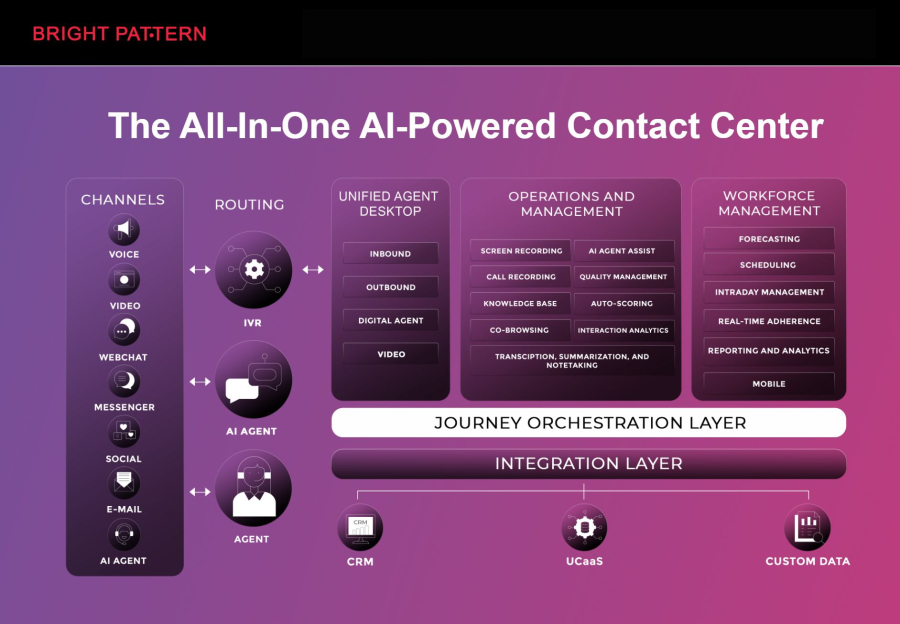
Bright Pattern is a top provider of cloud contact center software that combines voicebot conversational AI with intelligent routing, omnichannel communication, and advanced analytics. It helps businesses deliver faster, smarter, and more personalized customer support.
Key Features:
- Omnichannel support: calls, chat, email, SMS, and social media in one interface
- AI-driven automation to handle repetitive tasks and suggest agent actions
- Intelligent routing based on skills, history, and customer context
- Voicebot integration for natural, human-like customer interactions
- Real-time analytics for performance tracking and operational insights
- Easy integration with CRM, marketing, and cloud applications
- Scalable cloud infrastructure to meet demand without extra hardware
Bright Pattern empowers companies to provide exceptional customer experiences while increasing agent efficiency and business growth.
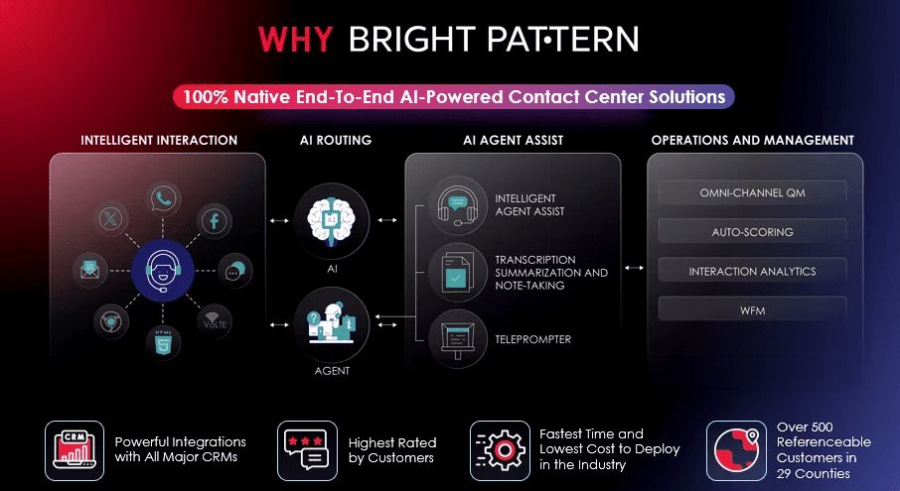
2. Genesys – AI Voicebot and Omnichannel Contact Center Solution
Genesys offers a cloud-based contact center with voicebot conversational AI, AI-assisted routing, and predictive engagement. It allows companies to deliver seamless customer experiences across multiple channels.
3. Five9 – Cloud Contact Center with AI Voicebot Automation
Five9 provides cloud contact center software that integrates AI-powered voicebots for automated responses, real-time reporting, and seamless CRM connectivity, improving efficiency and customer satisfaction.
4. NICE CXone – AI-Driven Voicebot Contact Center for Customer Experience
NICE CXone combines AI, analytics, and voicebot technology to optimize customer interactions, reduce call handling time, and enhance service quality across all communication channels.
5. Avaya OneCloud – Intelligent Voicebot Contact Center Platform
Avaya OneCloud offers AI-driven voicebot solutions, intelligent call routing, and omnichannel communication to help businesses improve agent productivity and customer engagement.
6. Talkdesk – AI Voicebot Contact Center for Smarter Customer Interactions
Talkdesk provides a cloud-native contact center platform with AI-powered insights and voicebot conversational AI, enabling faster issue resolution and better customer intelligence.
7. RingCentral – Voicebot Conversational AI Contact Center for Omnichannel Support
RingCentral delivers a cloud contact center with AI voicebots, intelligent routing, and analytics, helping organizations manage customer interactions efficiently across calls, chat, and social media.
8. Zendesk – AI Voicebot Contact Center and Customer Support Platform
Zendesk integrates voicebot automation with ticketing, live chat, and call center functionality, allowing agents to provide personalized support and faster issue resolution.
9. 8x8 – Cloud Contact Center with Voicebot Conversational AI
8x8 offers a unified AI-powered contact center with voicebot conversational interfaces, omnichannel communication, and reporting tools, improving customer engagement and operational efficiency.
10. Cisco Webex – AI Voicebot Contact Center for Seamless Customer Collaboration
Cisco Webex Contact Center combines AI voicebots, intelligent routing, and omnichannel support to enhance collaboration between agents and customers while streamlining service delivery.
How Voicebot Conversational AI Works
Behind every smooth voicebot experience is a stack of AI technologies working together in milliseconds. While implementations vary, most voicebots follow a similar flow:
- Automatic Speech Recognition (ASR)converts the caller's spoken words into text.
- Natural Language Understanding (NLU)analyzes the text to identify the caller's intent and extract key details (such as dates, amounts, or account numbers).
- Dialogue Managementdecides how the voicebot should respond, using business logic, context, and conversation design.
- Backend Integrationsconnect to your CRM, ticketing system, payment gateway, or custom APIs to retrieve or update data.
- Natural Language Generation (NLG)crafts a clear, human-sounding response in text form.
- Text-to-Speech (TTS)converts the response into spoken audio, using a synthetic voice that matches your brand.
This entire loop happens in real time, so callers experience a continuous, natural conversation with little to no delay.
Voicebots vs. Traditional IVR: What's the Difference?
Traditional interactive voice response (IVR) systems rely mainly on menu trees and touch-tone inputs. Voicebots, by contrast, use conversational AI to handle free-form speech and more complex requests.
|
Feature |
Traditional IVR |
Voicebot Conversational AI |
|
Interaction style |
Menu-based, "Press 1, Press 2" |
Natural language, "How can I help you today?" |
|
Understanding |
Limited to predefined options |
Understands varied phrases and intents |
|
Personalization |
Basic and rule-based |
Contextual, data-driven, and dynamic |
|
Complex tasks |
Challenging to implement and maintain |
Designed to handle multi-step workflows |
|
Customer experience |
Often feels rigid and frustrating |
Feels conversational and human-like |
By upgrading from IVR to voicebot conversational AI, organizations can keep the efficiency of automation while dramatically improving the caller experience.
Key Benefits of Voicebot Conversational AI for Your Business
When implemented thoughtfully, voicebots deliver measurable benefits across the organization. Some of the most compelling advantages include:
1. 24/7 Availability Without Extra Headcount
Customers expect help on their own schedule, not just during business hours. A voicebot is available day and night, weekends and holidays, answering calls, resolving issues, and escalating when needed.
This always-on support unlocks benefits such as:
- Serving customers in multiple time zones without additional shifts.
- Handling evening and weekend spikes, such as travel changes or urgent support.
- Ensuring that callers never hit a dead end or unanswered line.
2. Lower Call Handling Costs
Human agents are essential for complex, high-value interactions. But many incoming calls involve routine questions and simple transactions. Voicebots automate these repetitive tasks, so your team spends less time on basic queries and more time on work that truly requires human judgment.
Over time, this can reduce average handling costs per call, limit the need for seasonal hiring, and stabilize staffing requirements even as call volumes grow.
3. Faster Responses and Shorter Wait Times
Long hold times are one of the biggest drivers of customer frustration. Voicebot conversational AI responds instantly, triages requests, and often resolves them without queuing for an agent.
When escalation is needed, the voicebot can collect all relevant details first, so the agent joins a well-documented, already-qualified conversation instead of starting from scratch.
4. Consistent, Compliant Interactions
Voicebots follow your approved scripts, policies, and workflows every time. That is especially powerful in regulated industries such as finance, insurance, and healthcare, where consistent phrasing and data handling matter.
Well-designed voicebots can help ensure that:
- Legal disclosures are always read in full.
- Authentication steps are never skipped.
- Data is collected in a structured, auditable way.
5. Scalable Customer Experience
Traditional call centers struggle when volume surges unexpectedly. Hiring, training, and scheduling take time. A voicebot, on the other hand, scales elastically to handle more simultaneous conversations with minimal additional cost.
This scalability allows you to confidently run promotions, launch new products, or handle seasonal peaks, knowing your voicebot can absorb a significant share of the workload.
6. Actionable Insights From Every Call
Because voicebot conversations are digital end to end, they can be analyzed at scale. You gain granular visibility into why customers call, which intents are rising, and where journeys break down.
These insights feed continuous improvement:
- Optimize scripts and flows based on real customer language.
- Identify opportunities for new self-service features.
- Spot product or policy issues that trigger repeated calls.
Powerful Use Cases Across the Customer Journey
Voicebot conversational AI is relevant anywhere your customers use their voice to interact with your brand. Here are some high-impact use cases across industries.
Customer Support and Service
- FAQ and information: Answer common questions about opening hours, account status, coverage, eligibility, and more.
- Account updates: Let customers check balances, order status, delivery dates, or loyalty points using secure authentication.
- Technical troubleshooting: Guide callers through step-by-step diagnostics and fixes, escalating to agents only when necessary.
Sales and Lead Management
- Lead qualification: Ask discovery questions, understand needs, and route hot leads directly to the right sales reps.
- Inbound sales calls: Help callers explore product options, check availability, or locate the nearest store.
- Upsell and cross-sell: Offer relevant add-ons or upgrades based on customer history and intent.
Appointments and Reservations
- Booking and scheduling: Let customers book appointments, reservations, or service slots entirely via voice.
- Reminders and confirmations: Proactively call customers to confirm upcoming bookings and reduce no-shows.
- Changes and cancellations: Automate rescheduling, plan changes, or cancellations in a controlled, policy-driven way.
Billing and Payments
- Billing questions: Answer common queries about invoices, due dates, and charges.
- Secure payments: Collect payments over the phone using secure, compliant flows.
- Payment reminders: Gently remind customers of upcoming or overdue bills and offer convenient payment options via voice.
Proactive Outreach and Notifications
- Order and delivery updates: Notify customers of shipment status, delays, or successful delivery.
- Service alerts: Communicate outages, maintenance windows, or policy changes, and answer follow-up questions automatically.
- Surveys and feedback: Capture post-interaction feedback in a quick, conversational way.
Essential Capabilities to Look For in a Voicebot Solution
Choosing the right voicebot platform is critical to achieving a natural, effective experience. When evaluating solutions, pay close attention to the following capabilities.
Natural, Domain-Adapted Speech Recognition
High-qualityASRis the foundation of any voicebot. Look for engines that perform well with your specific use cases, accents, and terminology. Industry-specific vocabulary, product names, and acronyms should be recognized reliably.
Robust Natural Language Understanding
Your voicebot must understand what callers mean, not just what they say. EffectiveNLUhandles synonyms, paraphrases, and different ways of expressing the same intent. It should also extract key entities, such as locations, dates, or product codes, from natural speech.
Flexible Dialog Management
Real conversations are messy. People change their minds, ask follow-up questions, and jump between topics. A strong dialogue manager keeps track of context, manages turn-taking, and gracefully handles interruptions and clarifications.
Look for features such as:
- Context tracking across multiple turns in a conversation.
- Support for repair strategies (for example, confirming unclear data).
- Configurable business rules and workflows.
High-Quality, Brand-Appropriate Text-to-Speech
The voice of your voicebot is a core part of your brand experience. ModernTTSengines offer natural-sounding voices in multiple languages and tones. Ideally, you can fine-tune pace, intonation, and style to match your brand personality, from friendly and casual to formal and precise.
Omnichannel and Telephony Integration
For phone-based experiences, your voicebot must integrate smoothly with existing telephony infrastructure, such as SIP trunks, call routing, and contact center platforms. It should also be possible to share conversational logic across channels, so your strategy for voice and chat stays aligned.
Secure, Compliant Data Handling
Voice interactions often involve sensitive information. Prioritize solutions that support encryption, role-based access, and compliant data storage. If you operate in regulated markets, ensure that your provider supports relevant standards and can align with your internal security policies.
Analytics and Optimization Tools
Continuous improvement is core to voicebot success. Look for analytics that show:
- Top intents and topics.
- Drop-off points and confusion triggers.
- Containment rates (how many calls are resolved without an agent).
- Average handling time and escalation paths.
Easy-to-use tools for tuning, testing, and updating flows will help you refine the voicebot based on real data.
How to Design an Effective Voicebot Conversation
Technology is only half the story. The other half isconversation design— the art and science of crafting interactions that feel natural and get things done. A well-designed voicebot should feel helpful, efficient, and respectful of the caller's time.
Start With Clear Goals and Use Cases
Begin by defining what success looks like. Are you aiming to reduce call volume for specific topics? Improve after-hours coverage? Speed up authentication? Focus your initial design on a small number of high-value use cases and expand once you have traction.
Use Plain, Friendly Language
Write prompts in simple, everyday language. Avoid jargon, long sentences, or complex nested options. Typical best practices include:
- Ask one question at a time.
- Give examples of what the caller can say.
- Confirm critical information, such as payment amounts or dates.
Design for Real-World Behavior
People interrupt, change topics, and ask unexpected questions. Account for this by:
- Allowing barge-in, so callers can speak while the bot is talking.
- Supporting "help" and "repeat" at any point.
- Providing graceful fallbacks ("I'm not sure I understood, did you mean...").
Balance Automation With Human Escalation
Your goal is not to replace humans entirely, but tosupportthem and free them up for the work that matters most. Design smooth transitions from bot to agent, including:
- Passing along context, such as previous answers and customer profile.
- Setting expectations (for example, "I will connect you to a specialist; your estimated wait time is three minutes.").
- Allowing callers to request a human at any time for sensitive or complex issues.
Implementation Roadmap: From Idea to Live Calls
A structured rollout helps you deliver early wins while reducing risk. The following roadmap provides a practical approach to implementing voicebot conversational AI.
1. Discovery and Strategy
- Analyze current call volumes, topics, and pain points.
- Identify high-frequency, low-complexity interactions as initial targets.
- Define clear objectives and success metrics for your pilot phase.
2. Solution Design
- Map end-to-end call flows for each target use case.
- Design conversation scripts, prompts, and error-handling paths.
- Specify technical integrations with telephony, CRM, and backend systems.
3. Build and Integrate
- Configure intents, entities, and dialog flows in your chosen platform.
- Set up secure connectivity to your data sources and business applications.
- Fine-tune ASR and TTS settings to match your domain and brand voice.
4. Test With Realistic Scenarios
- Run internal tests with team members simulating real callers.
- Cover edge cases, background noise, and different accents.
- Refine prompts and flows based on feedback and call recordings.
5. Pilot Launch
- Start with a subset of traffic, such as after-hours calls or a specific phone number.
- Monitor performance closely and gather qualitative feedback from customers and agents.
- Iterate quickly to address friction points.
6. Scale and Optimize
- Gradually increase traffic handled by the voicebot as results improve.
- Add new intents and use cases based on observed demand.
- Continuously monitor KPIs and refine design for better outcomes.
Measuring Success: Key Voicebot KPIs
To demonstrate value and secure long-term support, you need to measure the impact of your voicebot initiative. Common metrics include:
Containment Rate
Containment ratemeasures how many calls the voicebot handles without transfer to a human agent. A higher containment rate typically means more automation and lower staffing pressure, as long as customer satisfaction remains strong.
Average Handling Time (AHT)
Track how long the voicebot takes to resolve calls or to route them to an agent with all necessary context. Reductions in AHT translate directly into efficiency gains and better customer experiences.
First Contact Resolution (FCR)
FCRcaptures how often a customer's issue is completely resolved in a single interaction, whether by the voicebot alone or with an agent's help. Well-designed voicebots can improve FCR by gathering accurate information and guiding callers more efficiently.
Customer Satisfaction and Net Promoter Score
Quantitative metrics should be paired with direct feedback. Short post-call surveys, sentiment analysis, and qualitative comments help you understand how customers perceive the voicebot experience and where to improve.
Operational and Financial Impact
Finally, connect voicebot performance to business outcomes such as:
- Reduction in total agent-handled call volume.
- Lower overtime or seasonal staffing costs.
- Increased capacity to handle peak volumes without service degradation.
- Improved sales conversion or reduced churn in specific journeys.
Future Trends in Voicebot Conversational AI
Voice technology is advancing quickly, opening up even richer possibilities for customer engagement. Some emerging trends to watch include:
More Human-Like, Expressive Voices
Advances in neural text-to-speech are making synthetic voices more natural, expressive, and emotionally aware. This helps voicebots sound less robotic and more aligned with brand personality, enhancing trust and comfort during sensitive interactions.
Deeper Personalization
As integrations expand, voicebots can leverage richer customer profiles and real-time context. Over time, this enables more personalized greetings, offers, and recommendations tailored to individual history and preferences.
Multimodal Experiences
Voicebots are increasingly part of broader, multimodal experiences where customers switch between voice, chat, and visual interfaces. For example, a customer might start a transaction via voice, then receive a confirmation or detailed instructions via text or email. Consistent context across channels will become a key differentiator.
On-Device and Edge Processing
Improvements in hardware and AI efficiency are making it possible to run parts of the voicebot stack closer to the user, reducing latency and enhancing privacy. This is especially relevant for automotive, smart home, and industrial scenarios.
Bringing It All Together
Voicebot conversational AI is no longer a futuristic concept. It is a practical, proven way to transform how your organization handles calls, supports customers, and scales operations.
By combining powerful AI technologies with thoughtful conversation design and a clear implementation roadmap, you can create voice experiences that:
- Delight customers with fast, frictionless service.
- Empower agents to focus on complex, high-value interactions.
- Reduce operational costs while improving availability and consistency.
- Generate rich insights to continuously refine your customer journeys.
For organizations ready to modernize their voice channels, investing in voicebot conversational AI is a high-impact step toward a smarter, more responsive customer experience.
